Lv. 1 Rudiments
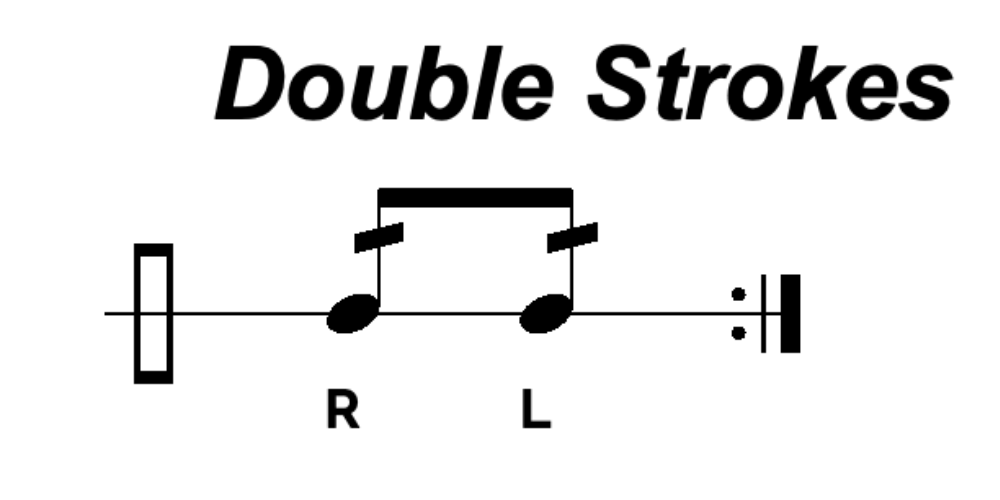
You may see this written differently elsewhere. This is a creative choice to help in the identification of a double stroke.
1. Efficiency and Speed:
A double stroke allows you to play two notes with a single motion of the wrist and arm. This is a game-changer for speed. Instead of having to physically move your arm up and down twice, you perform one motion and let the natural rebound of the stick and drumhead do the work for the second note. This drastically reduces the physical effort required to play fast passages, making it possible to play at tempos that would be impossible with single strokes.
Rolls: Double strokes are the primary mechanism for playing rolls. The ability to play continuous, smooth fast streams of notes is essential for creating convincing rolls.
2. Building Blocks for Other Rudiments:
The Core of Rolls: As mentioned, the double stroke roll is a fundamental rudiment in its own right, but it's also the basis for many other roll rudiments. For example, the 5-stroke roll, 7-stroke roll, and 9-stroke roll are all variations of the double stroke roll with a single stroke added at the end.
Paradiddles and Beyond: The double stroke is a key component of the paradiddle (RLRR LRLL), which is one of the most popular and versatile rudiments. Mastering double strokes is essential for playing all kinds of "diddle-based" rudiments and creating complex, flowing patterns around the kit.
3. Developing Advanced Technique and Control:
Rebound Control: Unlike single strokes, which rely on independent hits, double strokes force you to learn how to control the rebound of the stick. A clean double stroke requires you to manage the height, volume, and timing of the second "bounced" note. This trains your hands to be incredibly sensitive and precise.
Finger and Wrist Technique: At slower tempos, double strokes can be played with just the wrist, but as you speed up, you need to engage your fingers to "squeeze" the second stroke out of the stick. This finger technique is a hallmark of advanced drumming and provides an immense amount of control and speed.
Evenness and Consistency: A major challenge with double strokes is making sure both notes in the "double" sound identical. Practicing this rudiment with a metronome and focusing on evenness is one of the best ways to improve overall hand control and balance between your dominant and non-dominant hands.
Practice Tips
Start Slow
Use a metronome or choose a slow piece of music to help you stay consistent.
Experiment With Where You Hit The Skin (Batter Head)
Playing towards the rim is more bouncy
Playing in the middle of the batter head is less bouncy.
Stay Consistent
Keep the hight of your sticks even
Keep the rhythm even and stay in time
Practice regularly to help build your muscles and endurance
Get Used To Repetition
Settle in, and prepare to do the exercise over and over again
Playing along to music can help to provide variation and interest to your practice time. A 3min track also provides a good time marker as to how long you’ve been practicing.
Slowly Increase Your Tempo
When you feel comfortable playing through the rudiment slowly, incrementally increase the tempo then rehearse with this for a while. You’ll find that this will help you more effectively reach higher speeds rather than jumping straight to a speed in which you struggle